Made in America, Again: The Forces Driving U.S. Manufacturers Back Home and the Workers Who Stand to Gain
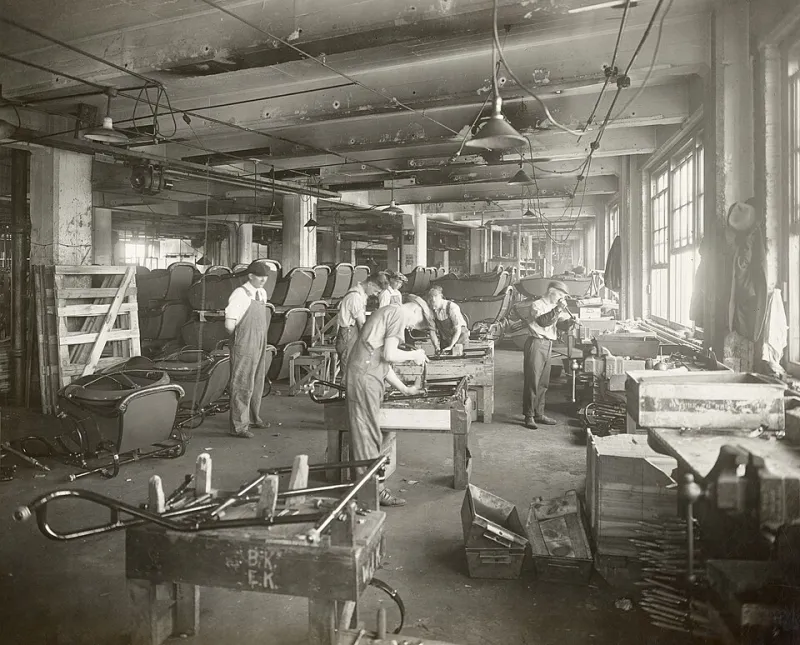
Photo: War Department. 1789-9/18/1947 Photographer: Harley-Davidson Motor Co. 1917-1918, Public domain, via Wikimedia Commons
For much of the late twentieth century, the calculus seemed simple: move production overseas, reduce costs, and improve margins. American executives followed that logic in waves, hollowing out manufacturing communities from Michigan to the Carolinas. Today, that calculus is being revised—sometimes reluctantly, sometimes with genuine conviction—as a new generation of corporate leaders confronts the hidden costs of a globally dispersed supply chain.
The reshoring trend is no longer a political slogan. It is a measurable, accelerating economic reality.
A Perfect Storm of Economic Pressures
The pivot back to domestic manufacturing did not happen overnight. Several forces converged to make offshoring less attractive than it once appeared.
First, labor costs in traditional low-wage manufacturing hubs have risen substantially. Wages in China's coastal industrial regions have climbed steadily for more than a decade, eroding the cost advantage that made overseas production so compelling in the first place. Vietnam, Bangladesh, and other emerging manufacturing destinations have followed a similar trajectory as their own labor markets tighten.
Second—and perhaps most dramatically—the COVID-19 pandemic exposed the fragility of extended global supply chains in ways that no boardroom risk assessment had fully anticipated. When semiconductor shortages shuttered automobile assembly lines in Ohio and Tennessee, or when pharmaceutical companies discovered that critical active ingredients were sourced almost entirely from a handful of foreign suppliers, the vulnerability became impossible to ignore. Corporate risk officers began reframing geography not merely as a cost variable but as a strategic asset.
Third, federal policy has added meaningful financial weight to the argument for domestic production. The CHIPS and Science Act, the Inflation Reduction Act, and the Infrastructure Investment and Jobs Act collectively direct hundreds of billions of dollars toward domestic manufacturing capacity in sectors ranging from semiconductors to clean energy. Tax credits, grants, and loan guarantees are changing the investment math for companies that might otherwise have deferred domestic expansion.
Where Reshoring Is Taking Root
The manufacturing repatriation is not evenly distributed across industries. Semiconductors represent perhaps the most visible front. TSMC's Arizona fabrication facility, Samsung's Texas expansion, and Intel's multi-site domestic investment program collectively signal a structural shift in where advanced chips will be produced. These are not marginal operations—they represent tens of billions of dollars in capital commitment and thousands of highly skilled jobs.
The electric vehicle supply chain is another focal point. Battery gigafactories are rising across the Southeast and Midwest, anchored by partnerships between automakers, battery manufacturers, and raw material processors. Communities that once mourned the closure of traditional auto-component plants are now welcoming facilities that, in some cases, employ more workers at higher wages than the operations they replaced.
Medical device and pharmaceutical manufacturing is attracting renewed domestic investment as well, driven by both corporate risk management and federal procurement preferences that favor American-made health products—a priority that gained urgency during pandemic-era supply disruptions.
What This Means for American Workers
The workforce implications of reshoring are substantial, but they carry important nuances that policymakers and corporate leaders alike must acknowledge honestly.
On one hand, the return of manufacturing creates genuine employment opportunities in communities that have struggled since deindustrialization began in earnest during the 1980s and 1990s. Many of the new facilities offer wages that exceed the local median, along with benefits packages that have become rare in lower-skill service employment.
On the other hand, modern manufacturing is not the labor-intensive industry it once was. Automation, robotics, and advanced process control mean that a new factory employing a thousand workers today might have employed four or five thousand workers in 1985 to produce equivalent output. The jobs that exist tend to require technical credentials—certifications in precision machining, industrial electrical systems, or programmable logic controllers—that many displaced workers do not currently hold.
This skills gap is arguably the central challenge of the reshoring moment. Community colleges and technical institutes in manufacturing-heavy states have expanded their programs, often in direct partnership with the companies building nearby facilities. Apprenticeship models, once common in American manufacturing and then largely abandoned, are experiencing a quiet revival. But the pace of workforce development has not always kept up with the pace of facility construction, leaving some new plants operating below capacity while qualified workers remain in short supply.
The Long View: Competitive Advantage and National Resilience
Beyond individual companies and communities, reshoring carries implications for the United States' broader competitive position in the global economy.
Economists who study industrial policy argue that manufacturing capacity and innovation are closely linked. When production moves offshore, the engineering knowledge, process expertise, and incremental innovation that occur on factory floors tend to follow over time. Rebuilding domestic manufacturing is therefore not simply about creating jobs—it is about preserving the technical capacity to compete in industries that will define economic power in the coming decades.
There is also a national security dimension that has moved from the margins to the mainstream of corporate and government strategy. Defense supply chains, critical mineral processing, and advanced materials production are now understood as strategic assets, not merely economic activities. The bipartisan consensus around this view—unusual in today's polarized political environment—suggests that the policy framework supporting reshoring is likely to persist across administrations.
None of this means that global supply chains will disappear. American companies will continue to source components, materials, and finished goods from international partners. But the era of unreflective offshoring—driven purely by labor cost arbitrage with little regard for resilience, quality control, or strategic risk—appears to be ending.
For American workers and the communities that depend on manufacturing employment, the reshoring revolution represents a genuine opportunity. Realizing that opportunity fully will require sustained investment in workforce development, thoughtful public-private partnership, and corporate leaders willing to take a longer view of what it means to build competitively in America.
The factories are coming home. The more important question is whether the country is ready to make the most of their return.